Extracting data from Form 6251 filings
Taxpayers attach Form 6251 to their 1040 when the alternative minimum tax applies or a credit requires it, on that year's IRS layout. Tax preparers onboarding new clients receive it inside each prior-year return, as a PDF from the client or a download from a tax portal.
Preparers need the alternative minimum taxable income, the exemption, the tentative minimum tax and the AMT owed. When a prior-year AMT liability may generate a minimum tax credit, Form 8801 uses the relevant Form 6251 amounts to calculate the credit allowed against a later year's regular tax.
What makes Form 6251 filings hard
An exemption table beside the line
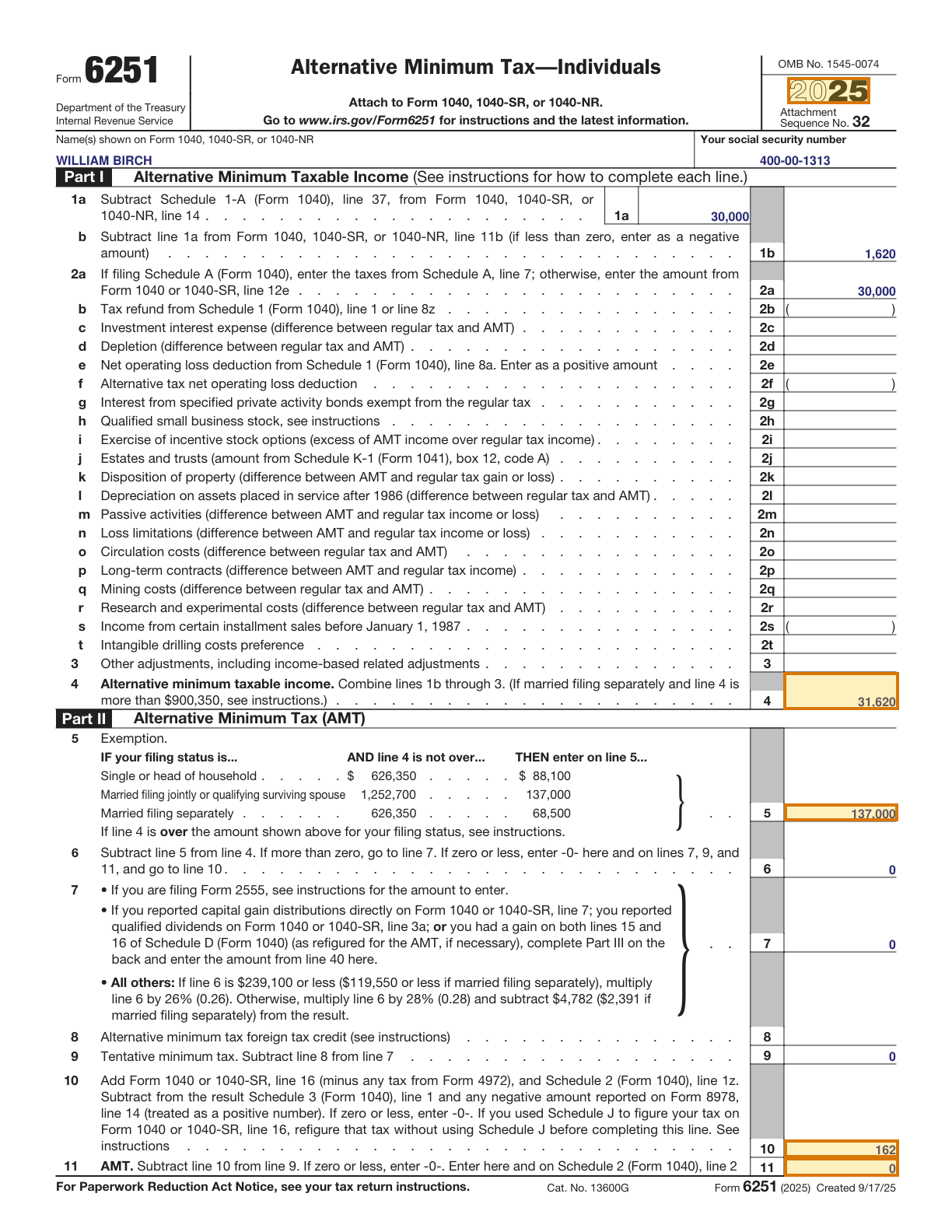
The exemption on line 5 depends on filing status, and the form prints a table of amounts by status right beside the line's own entry.
Two columns of amounts
Line 1a sits in an inner column to the left of the main amounts, so two columns of figures run down the same page.
The answer is a comparison
Line 11 is tentative minimum tax on line 9 less regular tax on line 10, and reads zero when regular tax is higher.
Parse, extract, verify
Parse
Parse turns the document into reading-order Markdown and a hierarchy of blocks (text, tables, figures), and grounds each block to its exact location on the page.
Extract
You define the fields in a JSON schema, and Extract returns their values in a consistent, structured format, each linked back to where it appears in the Markdown.
Verify
Each value links back to where it appears, down to the character range in the Markdown, and the page and bounding box in the source document, so every result can be verified.
One Form 6251, end to end
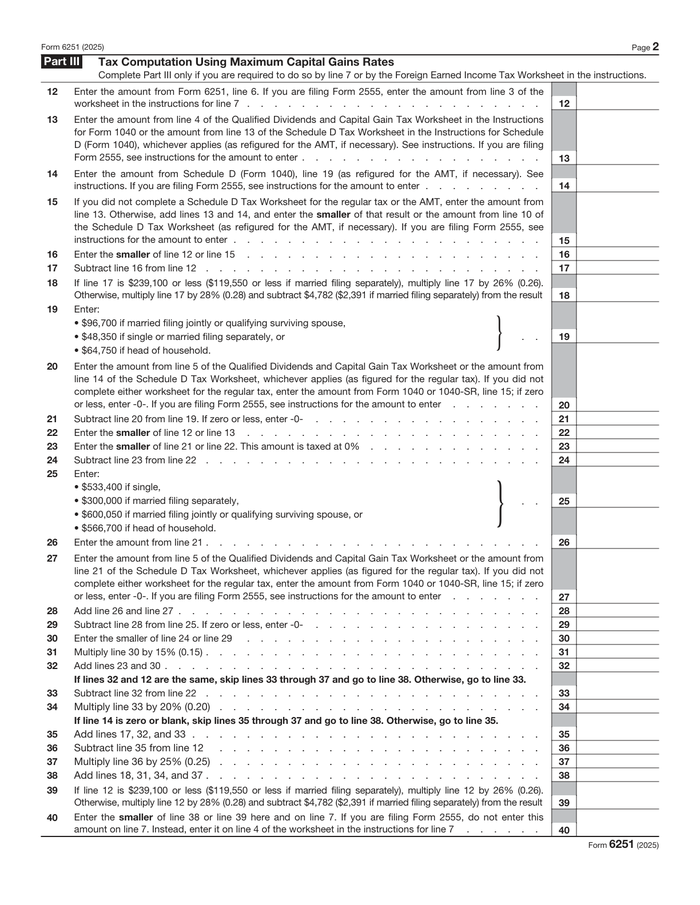
About this document: Form 6251 from an IRS e-file test scenario, published so tax software vendors can check their output against known answers. Two portrait pages: the AMT computation on page 1, and the capital gains rate section on page 2, which this filer leaves blank. Page 1 is featured. Every value is IRS test data for an invented taxpayer.
Processing objective: The objective is to follow the AMT computation in order, from the tax year to the answer. Income adjusted for the AMT is set against the exemption for the filer's status. The result is compared with the regular tax to decide whether any AMT is owed.
Demonstration fields: Tax year, Alternative minimum taxable income (line 4), Exemption (line 5), Regular tax (line 10), AMT (line 11)
The document
2 of 2 pages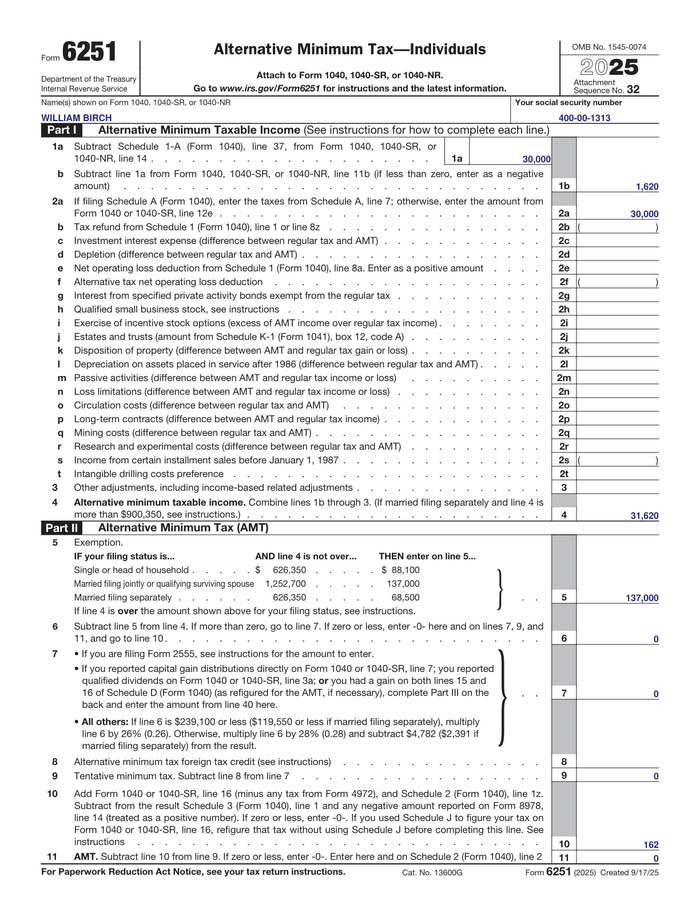 Page 1shown below
 Page 2
Where each value came from
tax_year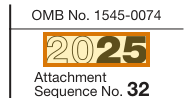
{
  "value": "2025",
  "page": 1,
  "range": {
    "end": 242,
    "start": 238
  },
  "box": {
    "xmin": 0.82714,
    "ymin": 0.06257,
    "xmax": 0.91351,
    "ymax": 0.0843
  }
}part_i_amti.line_4_amti
{
  "value": 31620,
  "page": 1,
  "range": {
    "end": 3894,
    "start": 3888
  },
  "box": {
    "xmin": 0.82325,
    "ymin": 0.54547,
    "xmax": 0.94375,
    "ymax": 0.57628
  }
}part_ii_amt.line_5_exemption
{
  "value": 137000,
  "page": 1,
  "range": {
    "end": 4583,
    "start": 4576
  },
  "box": {
    "xmin": 0.82391,
    "ymin": 0.65242,
    "xmax": 0.94336,
    "ymax": 0.66666
  }
}part_ii_amt.line_10_regular_tax
{
  "value": 162,
  "page": 1,
  "range": {
    "end": 6906,
    "start": 6903
  },
  "box": {
    "xmin": 0.82379,
    "ymin": 0.92498,
    "xmax": 0.9439,
    "ymax": 0.93969
  }
}part_ii_amt.line_11_amt
{
  "value": 0,
  "page": 1,
  "range": {
    "end": 7084,
    "start": 7083
  },
  "box": {
    "xmin": 0.82379,
    "ymin": 0.93965,
    "xmax": 0.94393,
    "ymax": 0.95482
  }
}
How to try it yourself
Everything on this page is reproducible. The sample, its schema, and the Parse and Extract API outputs are published. You can repeat the same two calls from whichever surface you already build on.
- Claude Skilldescribe the job; the agent writes it
- CLIno code at all
- MCPexpose ADE docs as an agent tool
- REST APIany language
- Pythonlandingai-ade
- TypeScriptlandingai-ade
Documents into data
Accurate
The best accuracy on the difficult documents other tools get wrong, such as messy scans, complicated tables, checkboxes and handwriting.
Auditable
Every answer cites its sources. Values come back with an audit trail (page, bounding box, character range) so a human can review them.
Agentic
Applies multi-step reasoning, and plans before it acts. Handles documents it has never seen before and adapts to variations.
API-first
Composable APIs that drop into any tech stack and can be called from anywhere. Easy to build on and embed in your pipelines and products.
Affordable
Cost-competitive rates with complete price transparency. Spend controls before you run, and every job reports its exact cost.
Enterprise-grade
Built for production and scale from day one. Fully observable and monitored, running securely in our cloud or yours.
Built for high-volume, high-throughput production
- Zero data retention
- Priority rate limits
- Enhanced support
- VPC and on-prem deployment
Available on Team and Enterprise plans.