Extracting data from arbitration awards
A tribunal issues one award at the end of a case, and courts enforce it. Each institution has its own house style: FINRA fills in a five-page form, an ICC tribunal writes a judgment past a hundred pages. Enforcement counsel, regulators and litigation databases take them by the thousand from public registers and case portals.
A reader needs the parties, the money, the fee split and what the panel refused. Regulatory disclosure systems publish those against a firm's record, and a court reads them when it is asked to enforce the award.
What makes arbitration awards hard
The ruling is written as prose
An award states the money in a sentence that also names which respondents owe it and to whom. No field holds it.
Liability splits between parties
Three respondents were held jointly and severally liable, the fourth released. Forum fees split the same way, $1,200 against $8,100.
Silence is a finding
A closing catch-all denies every claim the panel did not address, so relief that was never sought is refused in the same clause.
Parse, extract, verify
Parse
Parse turns the document into reading-order Markdown and a hierarchy of blocks (text, tables, figures), and grounds each block to its exact location on the page.
Extract
You define the fields in a JSON schema, and Extract returns their values in a consistent, structured format, each linked back to where it appears in the Markdown.
Verify
Each value links back to where it appears, down to the character range in the Markdown, and the page and bounding box in the source document, so every result can be verified.
One arbitration award, end to end
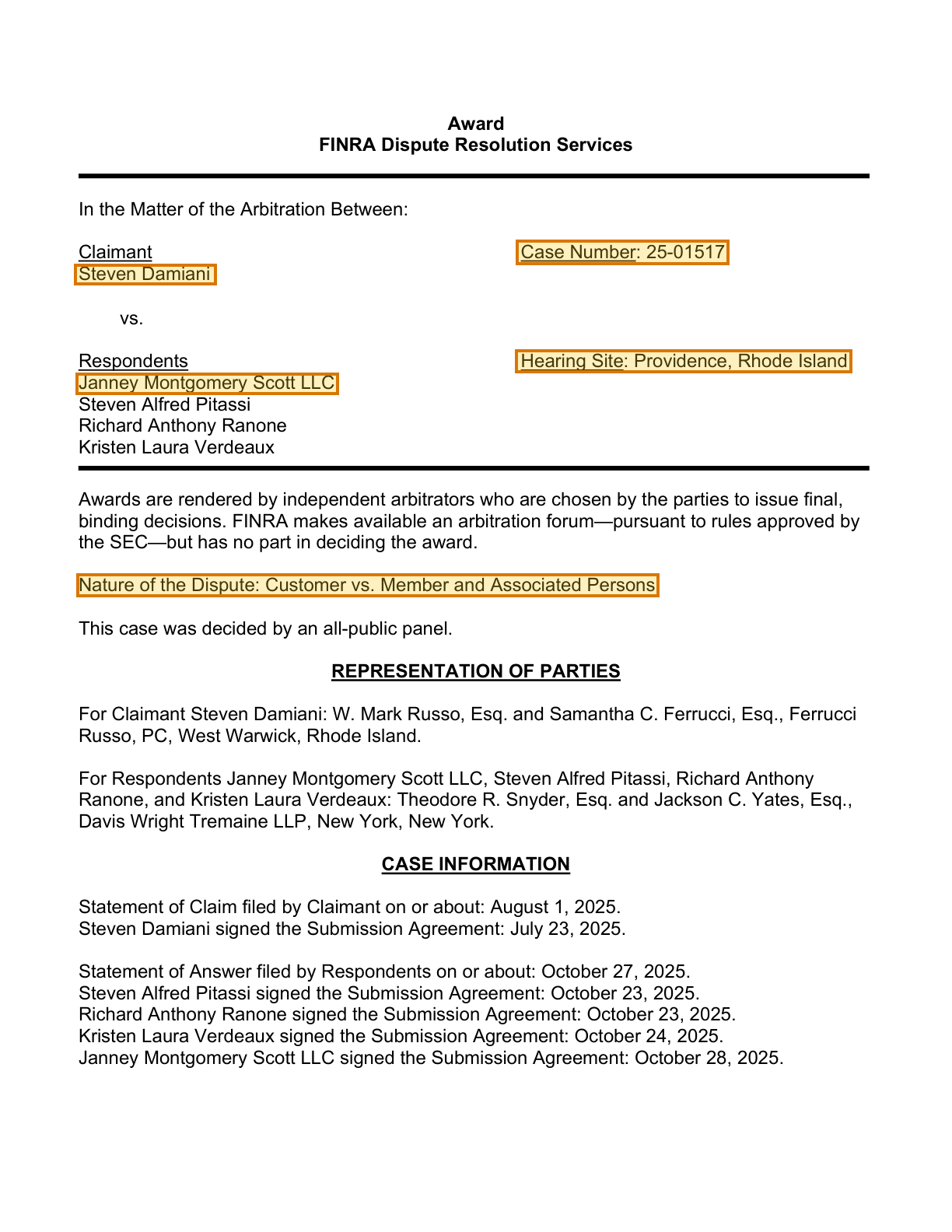
About this document: A FINRA arbitration award, case 25-01517, five portrait pages from FINRA's public Arbitration Awards Online database. A customer's claim against a broker-dealer and three of its associated persons, heard in Providence, Rhode Island. Page 1 is the case caption, pages 2 to 4 run as prose, and page 5 carries the three-member panel and its signatures. FINRA publishes every award it renders, and this one appears exactly as published.
Processing objective: The objective is to identify the award before reading it: the case number, the parties, the nature of the dispute and where it was heard. Anything that stores or retrieves an award is keyed on those, and each one grounds to its own line of the caption.
Demonstration fields: Case number, Claimant, Respondent firm, Nature of dispute, Hearing site
The document
4 of 5 pages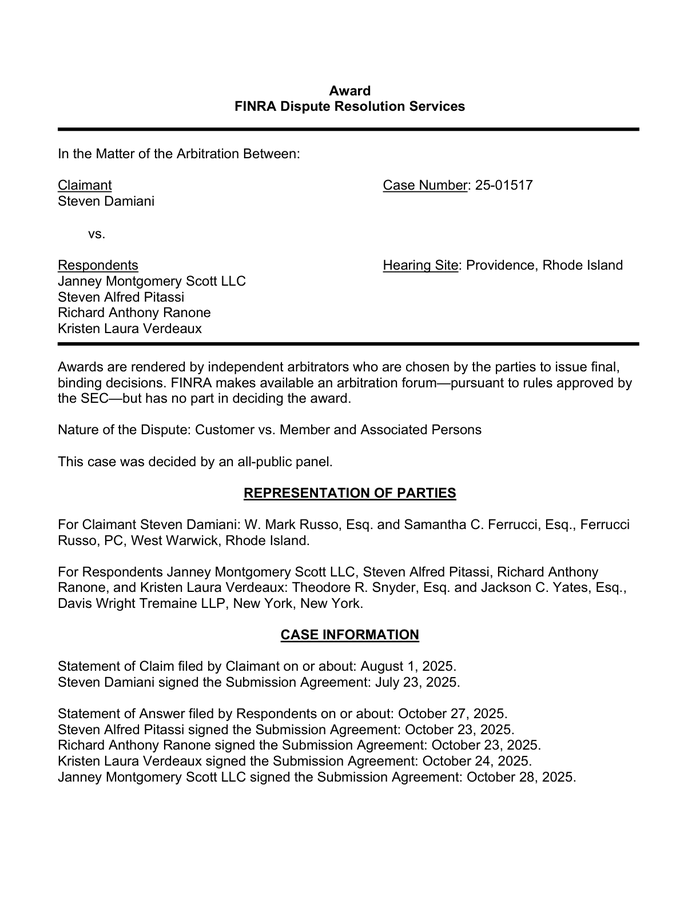 Page 1shown below
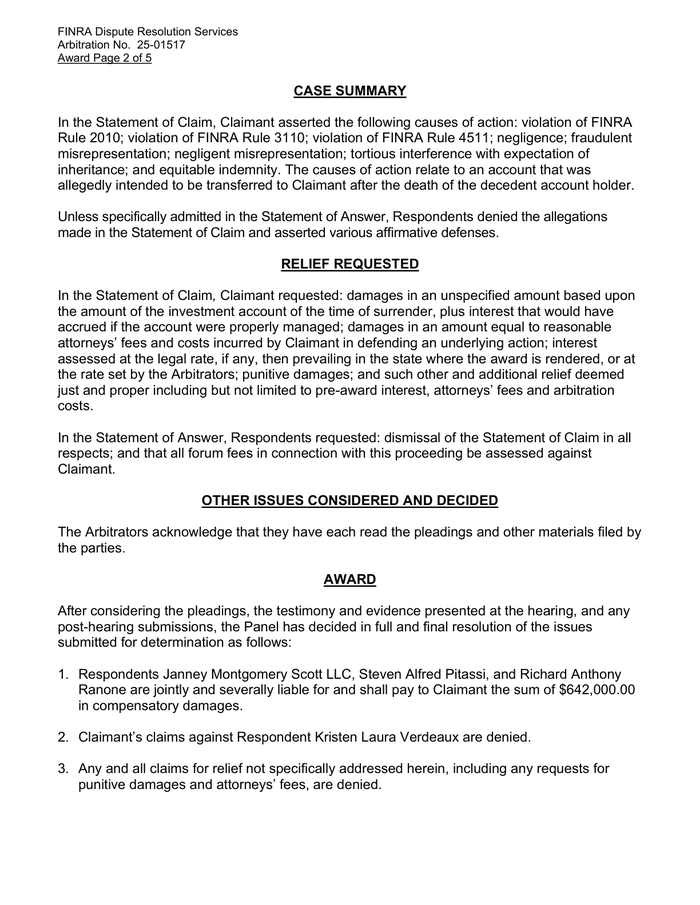 Page 2
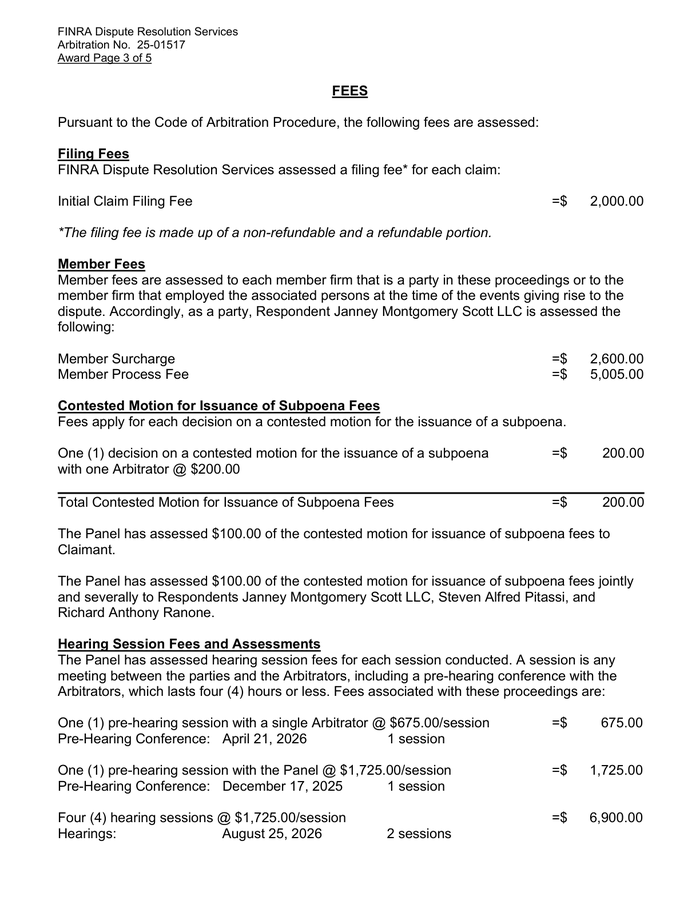 Page 3
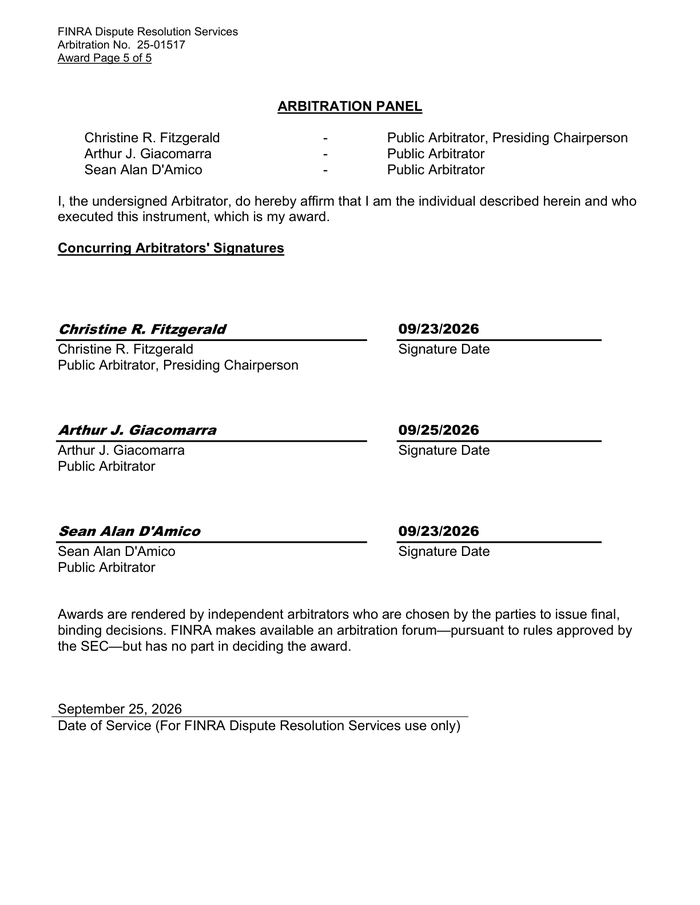 Page 5
Where each value came from
case.case_number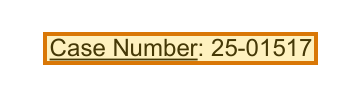
{
  "value": "25-01517",
  "page": 1,
  "range": {
    "end": 138,
    "start": 116
  },
  "box": {
    "xmin": 0.54183,
    "ymin": 0.19487,
    "xmax": 0.76602,
    "ymax": 0.21485
  }
}parties.claimants[0].name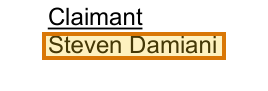
{
  "value": "Steven Damiani",
  "page": 1,
  "range": {
    "end": 110,
    "start": 95
  },
  "box": {
    "xmin": 0.07835,
    "ymin": 0.21421,
    "xmax": 0.22732,
    "ymax": 0.23161
  }
}parties.respondents[0].name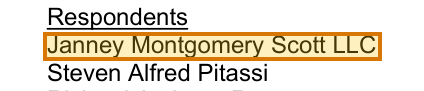
{
  "value": "Janney Montgomery Scott LLC",
  "page": 1,
  "range": {
    "end": 181,
    "start": 153
  },
  "box": {
    "xmin": 0.07985,
    "ymin": 0.30268,
    "xmax": 0.35609,
    "ymax": 0.32024
  }
}case.nature_of_dispute
{
  "value": "Customer vs. Member and Associated Persons",
  "page": 1,
  "range": {
    "end": 594,
    "start": 528
  },
  "box": {
    "xmin": 0.08017,
    "ymin": 0.4659,
    "xmax": 0.69222,
    "ymax": 0.48484
  }
}case.hearing_site_city
{
  "value": "Providence",
  "page": 1,
  "range": {
    "end": 292,
    "start": 253
  },
  "box": {
    "xmin": 0.54141,
    "ymin": 0.28353,
    "xmax": 0.89468,
    "ymax": 0.30296
  }
}
How to try it yourself
Everything on this page is reproducible. The sample, its schema, and the Parse and Extract API outputs are published. You can repeat the same two calls from whichever surface you already build on.
- Claude Skilldescribe the job; the agent writes it
- CLIno code at all
- MCPexpose ADE docs as an agent tool
- REST APIany language
- Pythonlandingai-ade
- TypeScriptlandingai-ade
Documents into data
Accurate
The best accuracy on the difficult documents other tools get wrong, such as messy scans, complicated tables, checkboxes and handwriting.
Auditable
Every answer cites its sources. Values come back with an audit trail (page, bounding box, character range) so a human can review them.
Agentic
Applies multi-step reasoning, and plans before it acts. Handles documents it has never seen before and adapts to variations.
API-first
Composable APIs that drop into any tech stack and can be called from anywhere. Easy to build on and embed in your pipelines and products.
Affordable
Cost-competitive rates with complete price transparency. Spend controls before you run, and every job reports its exact cost.
Enterprise-grade
Built for production and scale from day one. Fully observable and monitored, running securely in our cloud or yours.
Built for high-volume, high-throughput production
- Zero data retention
- Priority rate limits
- Enhanced support
- VPC and on-prem deployment
Available on Team and Enterprise plans.