Extracting data from appraisal reports
A licensed appraiser writes an appraisal report for most purchase and refinance mortgages. It uses the Uniform Residential Appraisal Report or an older GSE form, filled in the appraiser's own software. A lender's collateral review team receives one per loan, as a PDF and data file from an appraisal management company.
Collateral review needs the opinion of market value, the condition and quality ratings and each comparable's sale price and adjustments. The lender submits the report to the Uniform Collateral Data Portal for scoring, and sets the loan-to-value ratio from the value.
What makes appraisal reports hard
A grid across two pages
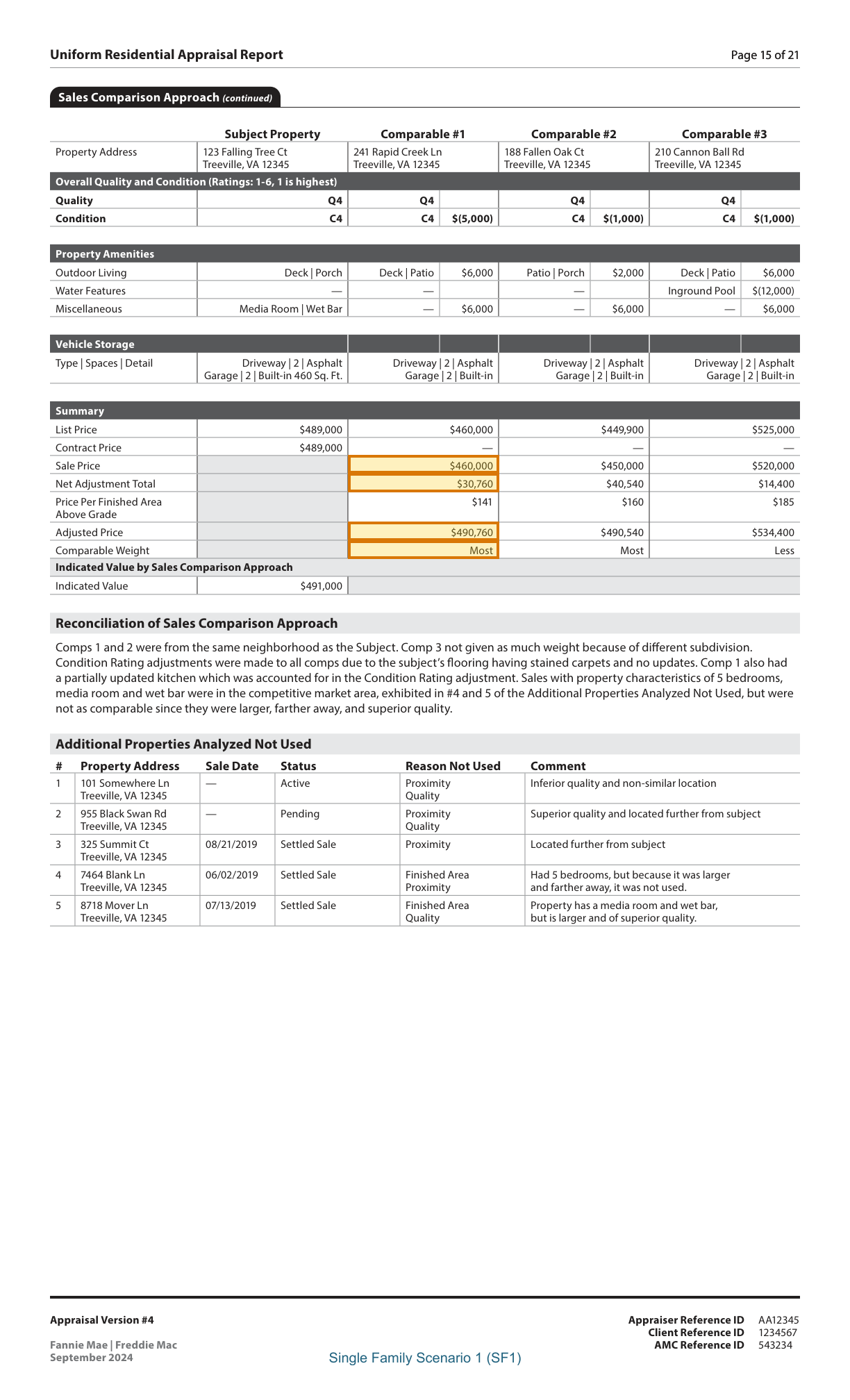
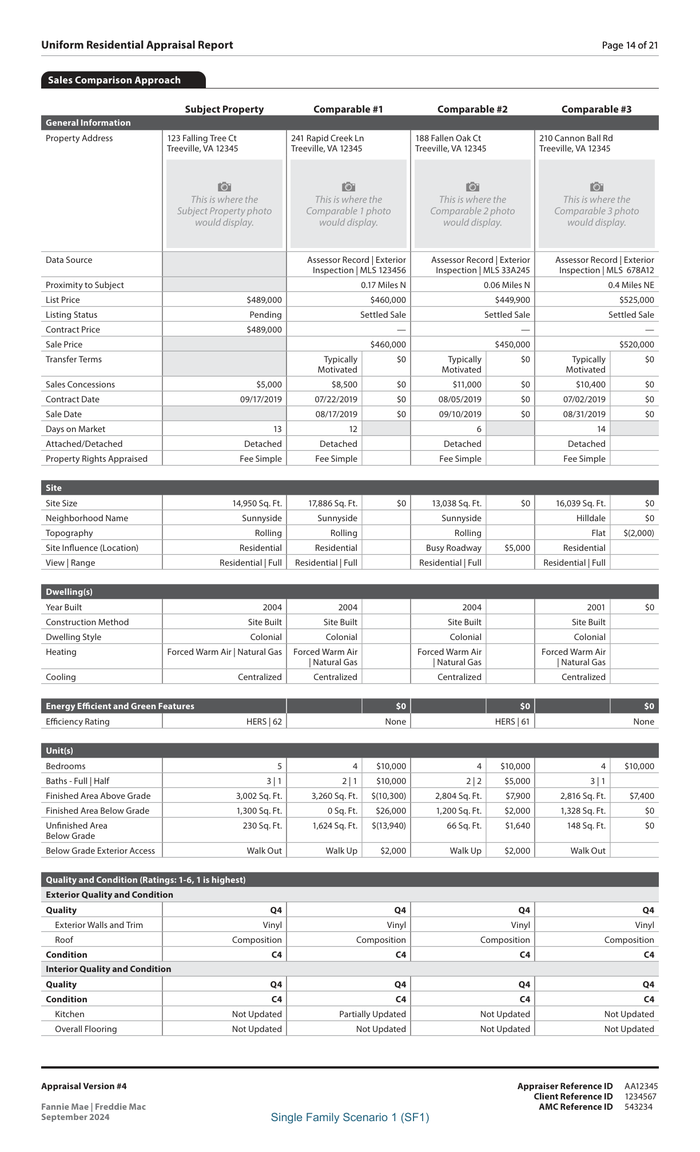
The sales comparison grid sets the subject beside each comparable, with value and adjustment columns side by side, and can run across two pages.
One value in many places
The opinion of market value appears on the summary page, in the reconciliation and beside the grid, each copy in a different context.
Two generations of form
Lenders receive both the retired form numbers, such as Form 1004, and the redesigned URAR, which arranges the same data in a new layout.
Parse, extract, verify
Parse
Parse turns the document into reading-order Markdown and a hierarchy of blocks (text, tables, figures), and grounds each block to its exact location on the page.
Extract
You define the fields in a JSON schema, and Extract returns their values in a consistent, structured format, each linked back to where it appears in the Markdown.
Verify
Each value links back to where it appears, down to the character range in the Markdown, and the page and bounding box in the source document, so every result can be verified.
One appraisal report, end to end
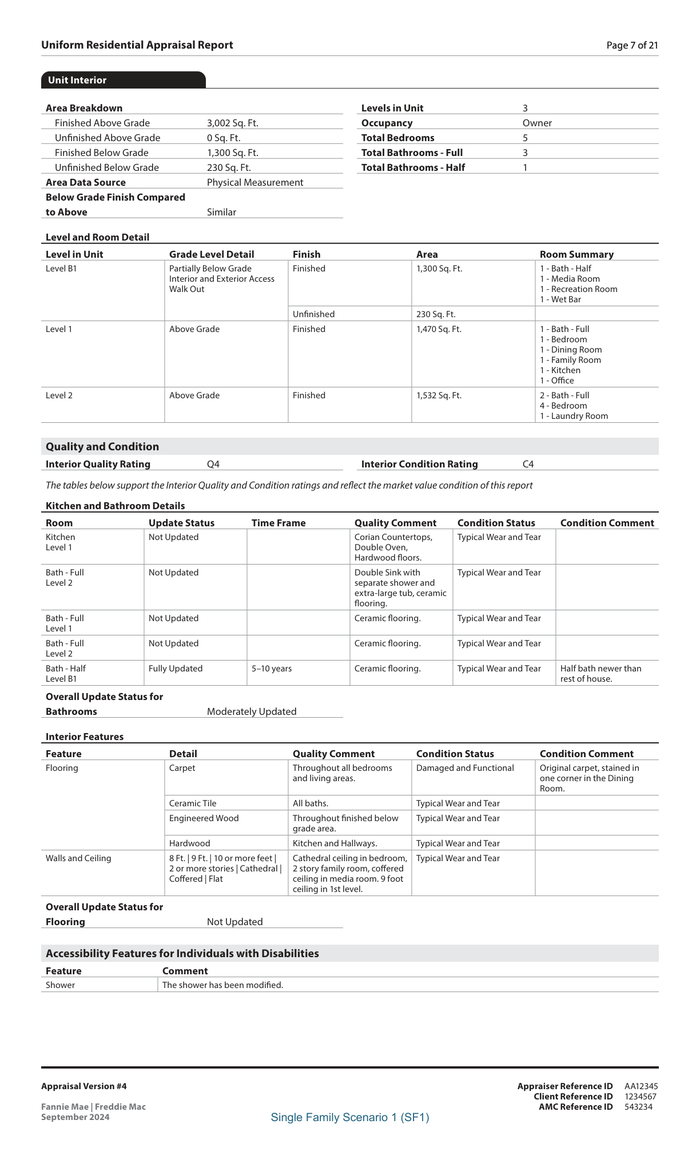
About this document: A complete Uniform Residential Appraisal Report in the redesigned UAD format, published by Freddie Mac and Fannie Mae as a sample scenario. It appraises a detached colonial subject to repair. Twenty-one legal-size portrait pages, from the summary through the sales comparison grid to the reconciliation. Page 15 is featured. Every name and address is specimen data, and the photo areas are grey placeholders.
Processing objective: The objective is to read one comparable's arithmetic from the grid's summary rows. The sale price plus the net adjustment gives the adjusted price, and a weight says how much the appraiser relied on it. Each value grounds to its own cell in that comparable's column.
Demonstration fields: Comp 1 sale price, Comp 1 net adjustment, Comp 1 adjusted price, Comp 1 weight
The document
4 of 21 pages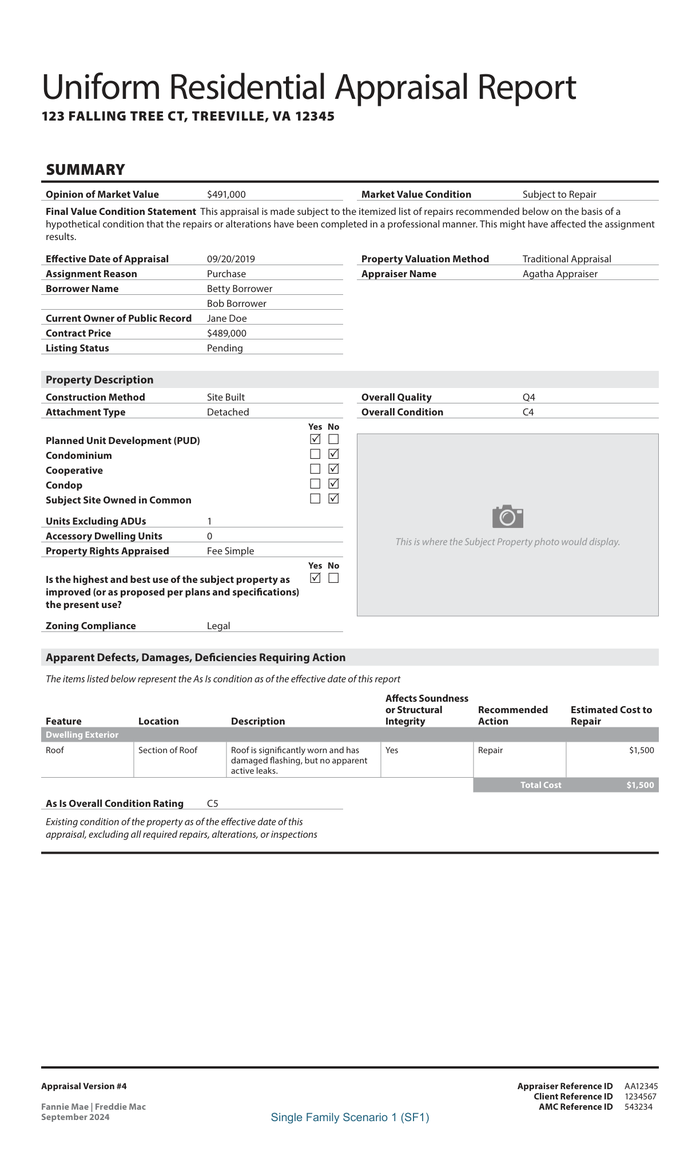 Page 1
 Page 7
 Page 14
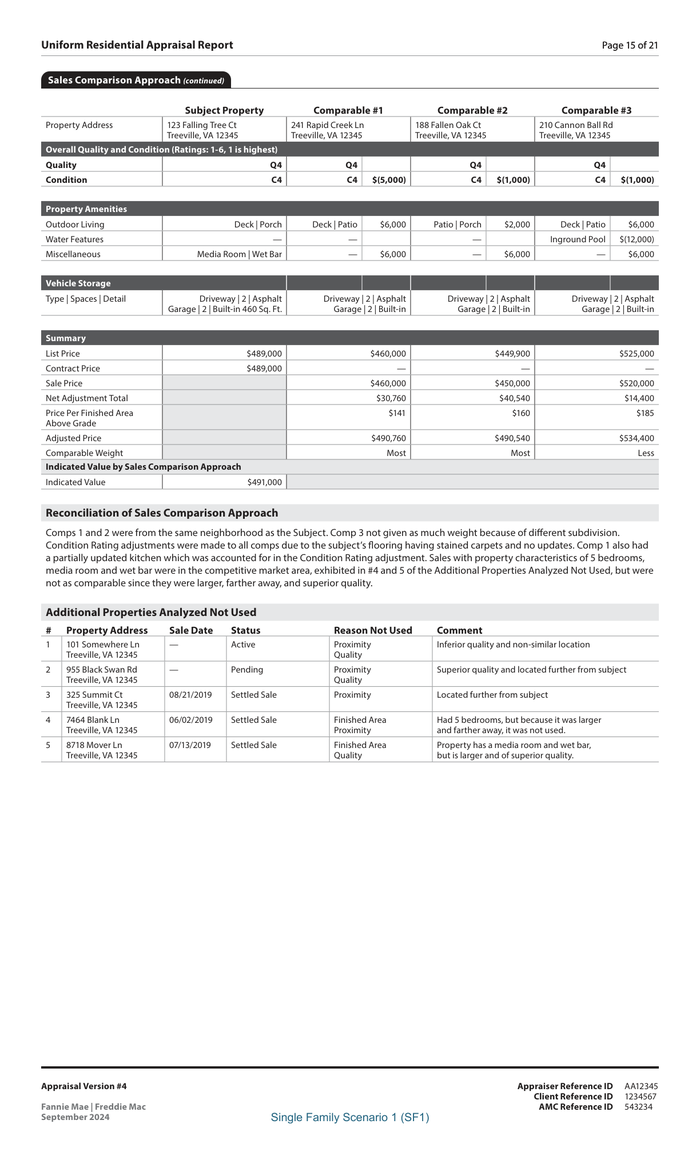 Page 15shown below
Where each value came from
comparables[0].sale_price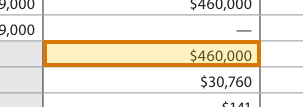
{
  "value": 460000,
  "page": 15,
  "range": {
    "end": 46179,
    "start": 46171
  },
  "box": {
    "xmin": 0.40955,
    "ymin": 0.32539,
    "xmax": 0.58703,
    "ymax": 0.33828
  }
}comparables[0].net_adjustment_total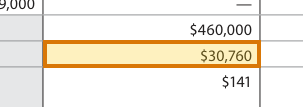
{
  "value": 30760,
  "page": 15,
  "range": {
    "end": 46277,
    "start": 46270
  },
  "box": {
    "xmin": 0.40955,
    "ymin": 0.33828,
    "xmax": 0.58703,
    "ymax": 0.35121
  }
}comparables[0].adjusted_price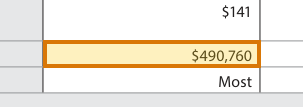
{
  "value": 490760,
  "page": 15,
  "range": {
    "end": 46470,
    "start": 46462
  },
  "box": {
    "xmin": 0.40956,
    "ymin": 0.37301,
    "xmax": 0.587,
    "ymax": 0.38596
  }
}comparables[0].comparable_weight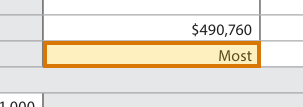
{
  "value": "Most",
  "page": 15,
  "range": {
    "end": 46562,
    "start": 46558
  },
  "box": {
    "xmin": 0.40956,
    "ymin": 0.38595,
    "xmax": 0.58699,
    "ymax": 0.39891
  }
}
How to try it yourself
Everything on this page is reproducible. The sample, its schema, and the Parse and Extract API outputs are published. You can repeat the same two calls from whichever surface you already build on.
- Claude Skilldescribe the job; the agent writes it
- CLIno code at all
- MCPexpose ADE docs as an agent tool
- REST APIany language
- Pythonlandingai-ade
- TypeScriptlandingai-ade
Documents into data
Accurate
The best accuracy on the difficult documents other tools get wrong, such as messy scans, complicated tables, checkboxes and handwriting.
Auditable
Every answer cites its sources. Values come back with an audit trail (page, bounding box, character range) so a human can review them.
Agentic
Applies multi-step reasoning, and plans before it acts. Handles documents it has never seen before and adapts to variations.
API-first
Composable APIs that drop into any tech stack and can be called from anywhere. Easy to build on and embed in your pipelines and products.
Affordable
Cost-competitive rates with complete price transparency. Spend controls before you run, and every job reports its exact cost.
Enterprise-grade
Built for production and scale from day one. Fully observable and monitored, running securely in our cloud or yours.
Built for high-volume, high-throughput production
- Zero data retention
- Priority rate limits
- Enhanced support
- VPC and on-prem deployment
Available on Team and Enterprise plans.